| Home | Search | Sitemap | Help | Contact | Sponsors |

|

|

|

|

|
| Home >> Article Database >> Old Photos May Hold Clues To Tyrrell's Mystery Quarries |
 |
|
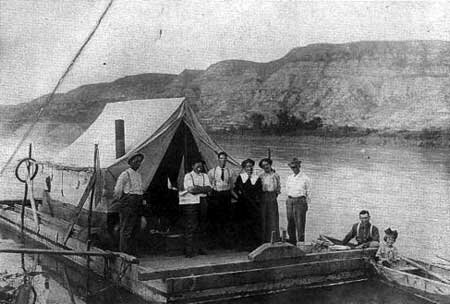
Old Photos May Hold Clues To Tyrrell's Mystery Quarries Alberta Connections Magazine By Marylu Walters Palaeontologist Barnum Brown's scow on the Red Deer River in Dinosaur Provincial Park (c.1912): (l to r) George Olson and Peter Kaisen from the American Museum of Natural History; second from far right (seated), George Sternberg. Others in the photo are unidentified. Credit: American Museum of Natural History. Palaeontologists who flocked to Alberta's badlands around the turn of the last century in search of dinosaur fossils rarely marked the location of their finds for future generations. That mystifies Darien Tanke, a technician with the dinosaur research program at the Royal Tyrrell Museum near Drumheller. "In their field notes, they might say a specimen was found five to 10 miles upstream from a certain community," Tanke says. "That’s like saying, go find the office desk that's eight miles down the street from you." Likewise, he says, "We might find a gaping hole in the side of a hill but not know what came out of it. The badlands are a complex topography and they have high erosion rates. So it's hard to say what came out of what hole." Tanke has begun a "mystery quarries" project to locate and mark all the fossil quarries in Dinosaur Provincial Park and to match specimens with the quarries they came from. "Certain types of dinosaurs are only found in certain layers. We need to see where various specimens are found in relation to each other to understand how they evolved. Also, sometimes you can go back and find pieces they (early paleontologists) left behind." In September 1999, Tanke issued a call for people whose families lived in the Brooks area during the Dinosaur Rush to bring in photos taken between 1913 and 1956 that might help locate quarries in the park. "A lot of the public used to come out to what is now Dinosaur Provincial Park on Sunday picnics. They would meet the palaeontologists and invite them for lunch. Then the palaeontologists would take them out to digs. We assume some people would have had cameras with them and that there would be pictures they took hidden away in old shoe boxes." Tanke's appeal has garnered "a few nibbles, but not quite the response we were wanting," he reports. By coincidence, a woman visiting from Denver has recently brought in three photo albums dating to 1921. Her father, then a student at the University of Alberta, had served as a field assistant for George Sternberg, a well-known palaeontologist. "He had photographed four different quarries, some of them with specimens still sitting in the ground," Tanke says. "We were able to compare rocks in the pictures with sites in the park. Things started falling into place." Tanke combines clues in photos with palaeontologist's field notes and objects found at quarries in the park to solve the riddle of who dug up what from where. The museum has marked close to 250 quarries and Tanke estimates as many more remain to be found. The "mystery quarries" project has attracted the interest of several individuals and companies. Bill Spencer, manager of business development for natural gas liquids with BP Amoco Canada, has contributed cash and equipment to the project. He had been involved in the Field Experience Program with the museum and his family has been active in historic preservation. "This quarry thing was a natural fit for me—history and dinosaurs," he explains. Spencer enlisted the help of Rob Prayer and Paul Cardiff of Calgary-based Ellipse Spatial Services and last summer they conducted a GPS (Global positioning system) survey of the park. BP Amoco and Novatel provided the use of a digital camera and state-of-the-art equipment for the project. The result is an aerial map with GPS coordinates for each quarry found. The team mapped about 60 quarries last summer and intends to return to the project this year. For information |
 |
 |
 |