| Home | Search | Sitemap | Help | Contact | Sponsors |

|

|

|
|

|
| Home >> Article Database >> The Field Italian Homecoming Reunion: Conversazione |
 |
|
The Field Italian Homecoming Reunion: Conversazione Researcher Seeks Information about Italian communities in southeastern Rockies By Michale Lang
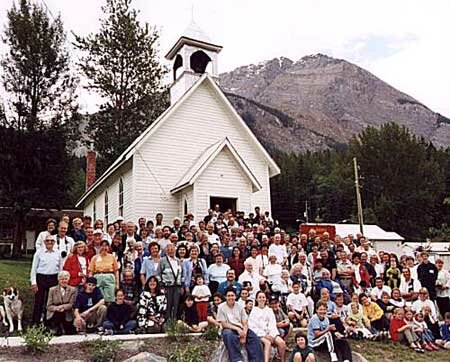
On July 17 and 18, 2000, over 200 Italians who had lived in Field, B.C. throughout the 20th century came home. They brought with them their children, grandchildren and great-grandchildren. They also brought their stories of life in a mountain village. The stories they told reflected happy memories of a beautiful place. Few spoke of the isolation or of the harsh environment. I wondered if, like me, some of those who came home also had sad memories of lives lost, either to change or death, if they shed some tears in private moments. I talked to some who visited the graveyard, a visit to those who are no longer with us an essential part of coming home. Sad memories remained unspoken. The life and vitality of the Italian people brought a palpable energy to the community. They brought the food of their culture to a potluck that at times seemed like a scene from a Fellini film, volunteers pushing their way through queues to get the food on the tables, children running around, and loud voices mingling in a mixture of Italian and English. Not everyone who came home was Italian. Ukrainian and other ethnic food also graced the table and everyone shared their memories of growing up together. Some schoolmates had not seen each other for over 30 years. "I still miss living here" were words I heard repeated again and again throughout the two days of the reunion. "I can't be away from the mountains for too long, or I just don't feel right." I never knew before that so many people shared my feelings about being without mountains. Most of the Italians who came to Field throughout the 20th century had no idea what they were coming to in these mountains. Like other immigrants, many of them fled situations of extreme poverty to find jobs and a better life for their families in a new land. They arrived to discover a cold, difficult place with few amenities. I was surprised to discover that, in the early part of the century, some men travelled to Canada to work for the summer and returned to Italy for the winter, many finding passage on Canadian Pacific's ships. I interviewed Gilbert Port, who is now 89. He came to Field at the age of 16 in the late 1920s and stayed until 1948. His father was one of those workers who made annual ocean crossings, working as a gardener for the YMCA during the summers and returning to his family in Italy every winter. His wife never came to Canada, but his sons immigrated to British Columbia and became hoteliers in Field and Kimberly. By the middle of the century, more workers brought their families and set about making homes for themselves. Often the men would come first to work for a few years, and their wives would follow later. Many of these immigrants came from Calabria in southern Italy. It must have been quite a shock to leave a Mediterranean climate and attempt to make a life in an alpine environment, but they succeeded. The Italians grew beautiful vegetable and flower gardens. Many of the women grew herbs on their windowsills throughout the year. Even in the 1970s, when I lived in Field, at least one Italian family raised chickens in their back yard for fresh eggs and meat. This was not a common thing to see in any town at the time. In the fall, trains would bring grapes from Calgary and many families made their own wine. Starting with the ingredients they grew, they introduced the community to the wonderful food that is so central to Italian culture. One of the Italians at the reunion dinner said that the tomato salad we served (thanks to Spolumbo's, an Italian Deli in Calgary) tasted exactly like his mother's tomato salad. For him, it brought back memories of childhood summers in Field. How his mother managed to grow tomatoes in Field baffles me. Because so many of these people spoke of how much they love the mountains and how good it was growing up there, it puzzles me that all of them left Field. Not one of the Italian families who lived and raised their children in Field stayed there. Neither did they all move to warmer, more forgiving climates. Although some moved to Golden, Central British Columbia, or Vancouver, many also moved to Alberta. They left for a variety of reasons, including retiring closer to their children or moving to where there was better work, but they all left Field. I am conducting a research project that will look at the life of Italians in Field and other communities in the Bow Corridor. If anyone has information about the Italian communities in the Rockies or would like to provide input, please contact me. I hope that the research will result in a book or series of articles and a video that will preserve these stories and document an important piece of immigration history. Thanks to funding from Museums Alberta, video documentation began at the Italian Homecoming in Field. The Homecoming reminded those of us who still live in the community of how much we lost when the Italians left. They brought a life and vibrancy to our little village that has not yet been replaced. We miss them, but we're glad they came home to visit for a few days in July. Michale Lang is a researcher/writer and museum consultant currently working at the Glenbow Museum, in Calgary. She has degrees in Historic Resource Management and Education and extensive experience in museums throughout the province of Alberta. She can be contacted at or you can write to her at 1640 Bowness Road, NW, Calgary, AB T2N 3J9. Her current email address is |
 |
 |
 |